Auto parts: how to sell over the phone and close on WhatsApp
For auto parts stores: how to turn the call from someone looking for a part into a recorded order sent to the store's WhatsApp, ready for the salesperson to close.
By industry5 min read
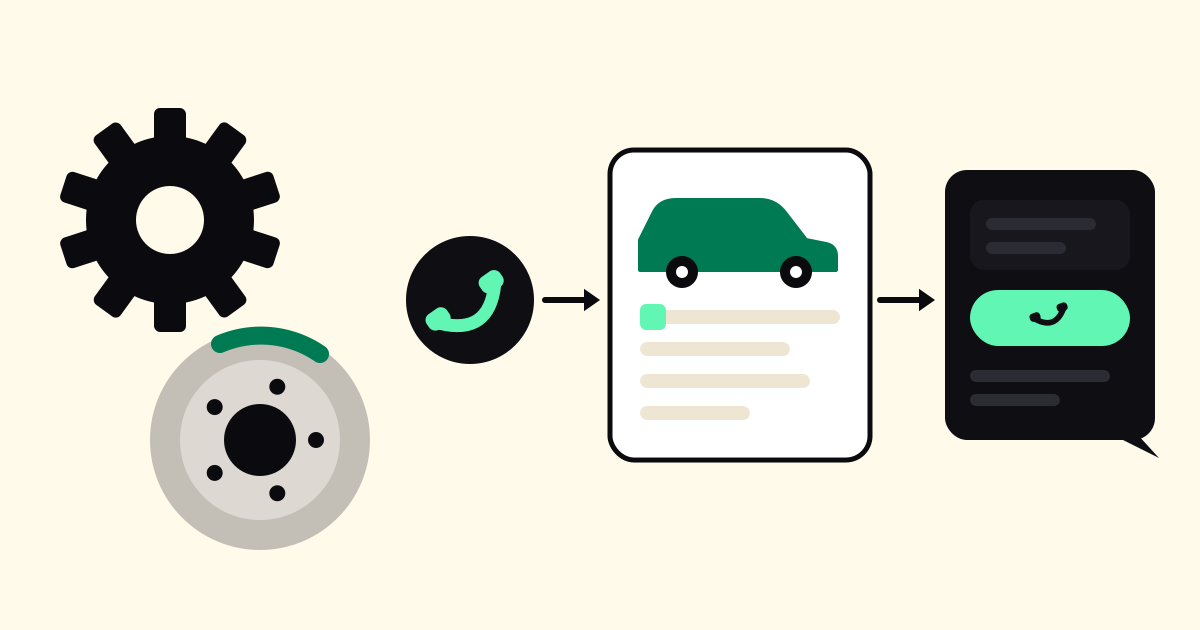
An auto parts store lives on the phone. The mechanic calls from the shop with the car on the lift and needs to know whether the part is in stock now. The driver calls to get a quote before taking the car in. The counter clerk answers the phone, searches the catalog, goes back to the customer at the counter, and in the middle of that another call rings. The one who loses out in this story is almost always the call.
The good news is that selling auto parts over the phone has a well-defined pattern: vehicle, part, quantity, delivery. That makes it much easier to organize the service, including with an AI attendant that records the order and hands it to the salesperson to close on WhatsApp.
Why the order gets lost on the phone
A few reasons show up in almost every store:
- A call during counter service. The salesperson chooses: serve whoever is in front of them or whoever is calling. One of the two waits.
- Incomplete information. "I need the brake pad for the Gol" turns into ten minutes of questions: year, engine, front or rear, with or without sensor.
- A quote that never comes back. The salesperson writes it on a piece of paper to follow up and the paper disappears.
- A call outside business hours. The shop works later, or starts before the store opens.
What to collect on every parts call
Define a collection standard. With it, both a new salesperson and an AI can record the complete order:
- Vehicle: make, model, year and engine. If possible, the license plate or the chassis number, which help identify the right part.
- Part: the name the customer uses and, if they know it, the code or preferred brand.
- Details: side (right or left), position (front or rear), version.
- Quantity.
- Delivery or pickup, with the address when it is delivery.
- Payment method.
- Name and phone number of the person placing the order (and of the shop, if applicable).
With these answers, the salesperson can check stock and give a price in a single contact.
AI phone to take the order and WhatsApp to close
Auto parts prices and availability change all the time and depend on checking stock and suppliers. That is why a setup that works well is to split the sale into two parts:
- On the phone: the AI answers, talks to the customer, collects everything from the list above and confirms the order out loud.
- On WhatsApp: the order arrives organized in the store's WhatsApp, with a link to call the customer. The salesperson checks stock, sends the price and closes.
This is exactly the "sell" role of Combot's AI Phone: the AI takes the order and sends it to the company's WhatsApp, with a link to call the customer. That way the AI does not need to know the price of each part, and the customer is not left waiting on the line while someone searches the system.
An illustrative example
Imagine (fictional example) a mechanic calling at 7:30 a.m., before the store opens.
The AI answers, explains that the store opens at 8 a.m. and asks what he needs. He asks for "a set of front brake pads and two discs for a 2019 Onix 1.0". The AI confirms the year and engine, asks whether it is delivery or pickup, notes the shop's address and name. The order arrives in the store's WhatsApp. At 8 a.m., the salesperson checks stock, calls the shop through the link and sends the price.
The mechanic did not have to call again, and the store started the day with a sale in progress.
And during business hours, with the store full
The AI does not have to answer only outside business hours. In a busy store, it can answer at all times and keep the salespeople at the counter. Other options:
- Take the order and send it on WhatsApp to the salesperson when the customer asks or when it is a walk-in customer with a question about an order in progress: the salesperson receives the case with the link to call the customer.
- Provide information on address, hours and payment methods, and point to WhatsApp for photos of parts.
You choose the AI's role for each time of day, according to the store's routine.
Tips for the auto parts script
- Ask for the license plate when possible. It helps identify the correct version of the vehicle.
- Always confirm side and position. The wrong part means a return, shipping costs and an irritated customer.
- Do not give the price over the phone if it changes a lot. Say that the salesperson will send the price on WhatsApp.
- Ask whether it is for today. This helps the salesperson prioritize orders.
- Ask for a photo when necessary. The AI can guide the customer to send the photo of the part on the store's WhatsApp.
Combot has a ready-made script for auto parts with these questions, for you to adjust to your stock and your region. See also our general guide on how to write the service script.
Answer quickly on WhatsApp
The most important point is not the AI: it is the follow-up. An order that has been taken only becomes a sale if the salesperson calls the customer soon. Some practices:
- Define who checks the orders arriving on WhatsApp at each time of day.
- Answer the evening orders first thing at opening.
- Use the link that comes with the order to call the customer directly, without looking up the number.
How much it costs
Combot's AI Phone costs R$ 399 per month per number, including the number and 500 minutes per month. To find out whether it pays off, count how many calls the store fails to answer per week and what the average order value is. If a few recovered sales pay for the monthly fee, it is worth testing.
Summary
Auto parts is one of the sectors where phone service has the clearest script: vehicle, part, quantity, delivery. An AI takes all of this down without rushing, at any time, and hands it to the salesperson to close on WhatsApp with the right price. If your missed calls happen mainly at night and early in the morning, also read how not to miss calls outside business hours.