Virtual phone agent for small businesses: how it works and when it's worth it
What a virtual phone agent with AI is, what it handles on its own, where it shouldn't step in and how to know whether it makes sense for your business.
AI Phone6 min read
In many small businesses, the phone is answered by whoever is closest: the owner in the middle of a quote, the salesperson with another customer at the counter, the technician with grease on his hands. When no one can answer, the call simply gets lost. And someone calling a business usually wants to get something sorted now: find out a price, book an appointment, place an order.
The virtual phone agent was born for this gap. In this guide, we explain what it is, what you can delegate to it, what you can't, and how to decide whether it makes sense for your business.
What a virtual phone agent is
It's a phone number answered by an artificial intelligence that talks with a natural voice. The person calls, the AI answers, understands what they say (no need to press keys) and responds as an attendant would, following the script the business has defined.
It's different from the old IVR, that recording that says "press 1 for sales, press 2 for finance." An IVR only routes. The AI agent converses, asks for what's missing, takes notes and handles what's within its reach. If you want to understand the difference in detail, we wrote an article just about that: IVR or AI agent.
It's also different from a WhatsApp bot. The bot responds by text, at the customer's pace. The phone is a live conversation, for someone who wants to talk now, often because they're driving, at work or simply prefer to speak.
What it can do on its own
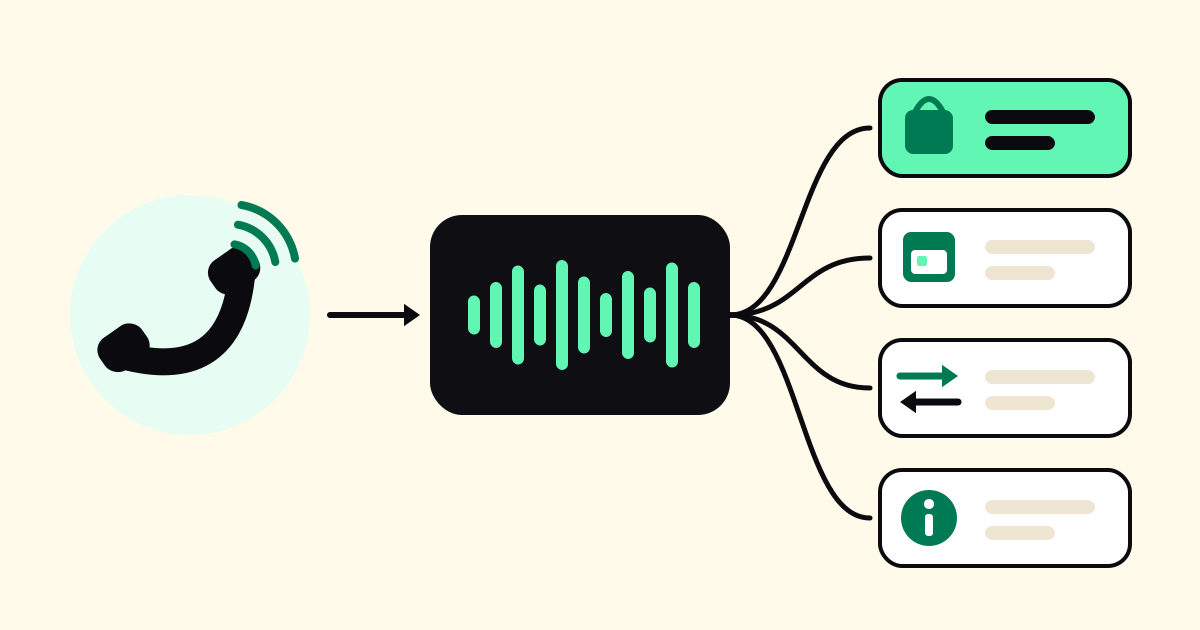
The main point is that the agent doesn't need to do everything; it needs to do well what you choose. In Combot's AI Phone, the business defines the AI's role on each number:
- Sell: the AI talks with the customer, takes the order (what they want, quantity, address, payment method, whatever matters in your field) and sends everything to the business's WhatsApp, with a link to call the customer and close the sale.
- Schedule: the AI checks the calendar, offers the available times and books whatever the customer chooses.
- Take a message and pass it to the team: the AI understands the subject, notes the name, phone number and the case and sends it to the right person on the team's WhatsApp, with the link to call the customer.
- Inform: the AI answers questions (address, hours, what the business does, how it works) and points to the website or WhatsApp for the next step.
And outside business hours you choose another behavior: the AI takes the message and sends it on WhatsApp, only states the opening hours, or simply doesn't answer.
What it shouldn't do
A well-configured virtual agent knows what isn't its job. A few examples:
- Negotiate special conditions. Off-list discounts, different terms, exceptions: that's a decision for people. The AI takes the request and your team responds.
- Give a diagnosis. In a clinic, the AI books the appointment; it doesn't say what the person has. In a repair shop, it notes the symptom; it doesn't give the repair quote without the mechanic seeing the car.
- Promise what you haven't defined. If the script doesn't mention same-day delivery, the AI shouldn't make it up. That's why the script is so important (see how to write the service script).
- Handle a delicate case to the end. A serious complaint, a very upset customer, a legal matter: the best approach is for the AI to note the case and send it to the right person on the team via WhatsApp, with the link to call the customer.
Who it makes the most sense for
There is no single rule, but some signs show up often in companies that benefit:
- The phone rings while everyone is busy with the customer in front of them.
- Many of the calls are the same questions: opening hours, address, whether you have a certain product, how much a certain service costs.
- Calls come in outside business hours and nobody knows how many were missed.
- The company advertises a number (on Google, on the storefront, on the van, on the flyer) and has no way to guarantee it will be answered.
- The owner wants to see what was discussed, instead of relying on "I think someone called".
The industries vary a lot: internet provider, auto parts, clinic, repair shop, law firm, real estate agency, bakery, travel agency, fire extinguisher company. Combot comes with ready-made scripts for more than 100 industries, which serve as a starting point and you adjust them to your way of working.
An illustrative example
Imagine a neighborhood building materials store (fictional example, just to show the flow). A customer calls at 7:40 pm, after the store has closed, looking for sand and cement for the next day.
The AI attendant answers, explains that the store opens at 7 am, asks what he needs, notes down "10 bags of cement, 2 meters of medium sand, delivery to such-and-such street" and the customer's phone number. At 7 am, the salesperson opens the store's WhatsApp and the order is there, with a link to call the customer and confirm the price.
Without the attendant, that call would ring into the void. The customer would probably call another store.
How to assess whether it is worth it
Do the math with your own numbers, not with promises. A simple path:
- Count the calls. For one or two weeks, note how many calls come in, how many are answered and how many ring without an answer. The phone bill or the cell phone history help.
- Classify the subjects. How many are simple questions, how many are orders, how many really need a person?
- Estimate the value of a customer. How much is an order or an appointment worth, on average, in your business?
- Compare with the cost. Combot's AI Phone costs R$ 399 per month per number, already including the number and 500 minutes per month. If the recovered calls pay for that with room to spare, it makes sense to test it.
If you want to compare with hiring a person for the phone, we have a dedicated article: receptionist or AI phone. One thing does not have to exclude the other: many companies use AI to cover hours and peaks, and the team keeps what requires people.
Care points during rollout
- Start with a single role. Choose the most important function (sell, schedule, take notes and send on WhatsApp, or inform) and get it solid before thinking about another.
- Write the script with whoever answers today. Whoever answers knows the questions that repeat and the answers that work.
- Call yourself. Test as a customer: ask in different ways, interrupt, ask for something outside the script. Adjust whatever sounds strange.
- Read the first conversations. In the first weeks, review the call summaries to find questions the script does not yet cover.
- Let the team know. Whoever receives the order on WhatsApp needs to know they should respond quickly. AI opens the door; the sale depends on whoever closes.
- Take care of the data. Ask only for what you need to serve and handle everything in accordance with the LGPD. We explain in LGPD in phone and WhatsApp service.
Summary
A virtual attendant by phone does not replace the relationship your team builds. It ensures that no call goes unanswered, handles what is repetitive and delivers to the team, organized, what needs a person. For a small business, this usually means fewer interruptions during the day and fewer lost customers at night and on weekends.