How not to lose calls outside business hours
A call that rings at night, at lunch or on the weekend is a customer going to the competitor. See the options, from the recorded message to the AI agent, and how to choose.
AI Phone5 min read
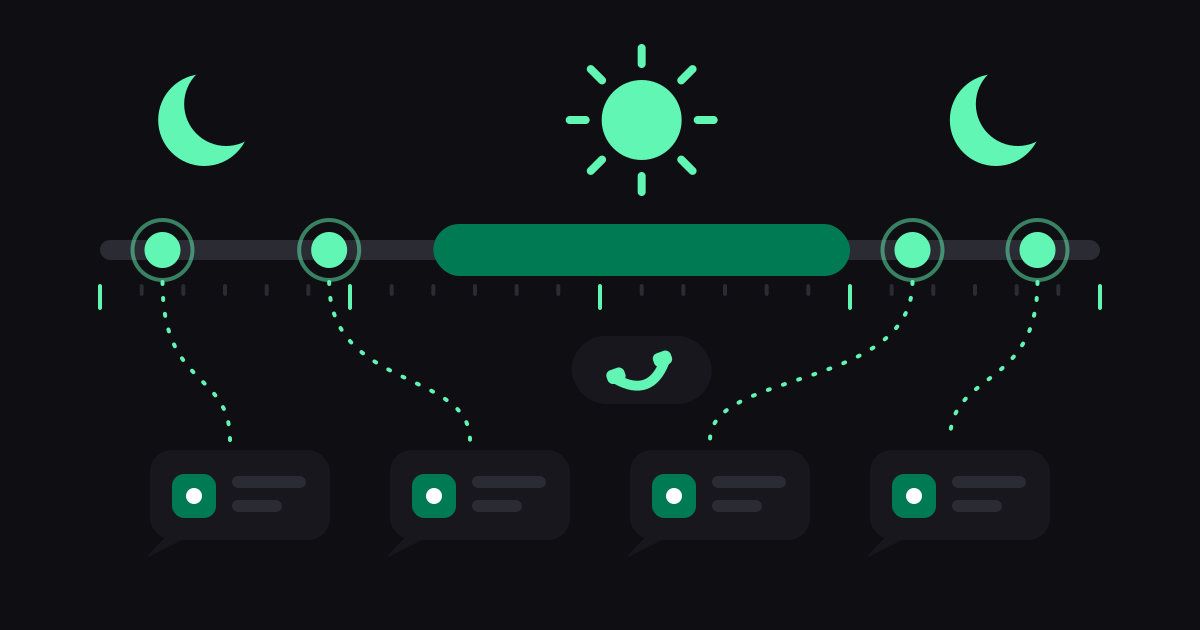
Business hours are the company's hours, not the customer's. Customers call when they remember, when the problem appears or when they finally have a free minute: at lunch, after their workday, on Saturday afternoon. If your company only answers from 8 a.m. to 6 p.m., all those calls fall into a void.
The worst part is that a missed call doesn't show up in anyone's report. There's no complaint, no record of a lost sale. The customer just calls the next one on the list. In this article, we show how to find out the size of the problem and the options to solve it.
First, find out how many calls you're losing
Before choosing a solution, get an idea of the volume. Some simple ways:
- Device or carrier history. Cell phones and many phone systems show missed calls with date and time. Export or photograph them for two weeks.
- Ask whoever answers. The team can tell you at what times the phone rings and nobody picks up: opening, lunch, shift change.
- Watch the next day. How many customers start with "I called yesterday and nobody answered"? Each one of them is someone who persisted. Many don't persist.
With that you'll have two numbers: how many calls fall outside business hours and how many fall within business hours but with no one available. Both count.
The options, from simplest to most complete
Recorded message with the hours
It's the minimum: whoever calls outside business hours hears "our service is Monday to Friday, from 8 a.m. to 6 p.m." At least the customer isn't left without an answer. But they also don't leave a message, and the chance of them calling back depends only on their goodwill.
Voicemail
Better than nothing, but few people leave a message on voicemail today. And those who do tend to speak quickly, without a name or a complete number. Someone still has to listen to each message, write it down and call back.
Forwarding to someone's cell phone
It works for very small companies, but it turns the owner or an employee into an endless on-call duty. After a few weeks of answering customers at dinner, the tendency is to let the cell phone ring.
Outsourced call center
A call center with human agents can take messages outside business hours. It's a valid option, especially when service requires human judgment. Cost and quality vary widely; ask for a proposal and test before hiring.
AI agent
The AI answers at any time, with a natural voice, understands what the person says and follows the company's script. In Combot's AI Phone, you choose what happens outside business hours:
- Take a note and send it on WhatsApp: the AI talks, understands what the customer wants, gets their name and phone number and sends everything to the company's WhatsApp, with a link to call the customer. In the morning, the team already starts with the list ready.
- Just state the hours: the AI answers and informs when the company opens, the address or the website. Useful when you don't want to create any commitment outside business hours.
- Don't answer: for those who prefer that the number simply doesn't answer outside business hours.
And during business hours it can play another role, such as selling, scheduling an appointment or taking a note and sending the case to the team's WhatsApp.
How to choose
A few questions help you decide:
- Is the customer calling at night trying to solve something urgent, or just trying to get ahead? If it's urgent (a leak, internet down, a tow truck), telling them the hours isn't enough. If it's getting ahead (a quote, an order for the next day), taking a message and sending it on WhatsApp does the job.
- Can you respond to the message quickly the next day? There's no point taking a message if nobody follows up. Define who checks WhatsApp at opening.
- How much is a recovered call worth? Compare it with the cost of the solution. Sometimes a single customer recovered per month pays the bill.
- How much of the service requires a person? If almost everything is "what are your hours, how much does it cost, do you have such and such," the AI handles it well. If almost everything is negotiation, it takes a message and passes it on.
An illustrative example
Think of an auto repair shop (fictional example) that closes at 6 p.m. At 9 p.m., a driver calls because her car started making a noise at the wheel and she wants to bring it in the next day.
The AI answers, explains that the shop opens at 8 a.m., asks for the car model, what's happening and whether she can drop the car off in the morning. It notes everything and sends it to the shop's WhatsApp. At 8 a.m., the attendant calls the customer back using the link that came with the message and confirms the appointment.
The driver didn't have to call again, and the shop didn't lose the job to the competitor who answered first.
Don't forget lunch hours and peak times
After hours isn't just at night. Lunch, early morning and busy days also leave calls unanswered. An AI that answers when no one is available covers those gaps. If your team handles calls well when they're free, use the AI as backup rather than a substitute: it takes down the details and sends them to the right person on WhatsApp, so no one is left without a follow-up.
Adjust the script for closed hours
The after-hours script is different from the daytime script. A few things to keep in mind:
- State clearly that the business is closed and when it opens.
- Don't promise a follow-up at a time the team can't meet. "We'll get back to you the next morning" is better than "we'll get back to you in minutes."
- Ask only for what's necessary: name, phone number and what the person needs.
- If there's an on-call service for emergencies, explain how to reach it.
We have a step-by-step guide for this: how to write your company's service script.
Summary
An after-hours call is real demand, just invisible. Measure how many you're losing, decide what the customer needs to hear at that moment and choose the solution that guarantees a response. For most small businesses, taking the message and delivering it to the team on WhatsApp the next day already solves most of the problem.