IVR vs. AI attendant: which to choose for your company's phone line
The "press 1, press 2" IVR and the AI attendant that converses solve different problems. Compare how each one works, what it costs and when to use each.
AI Phone5 min read
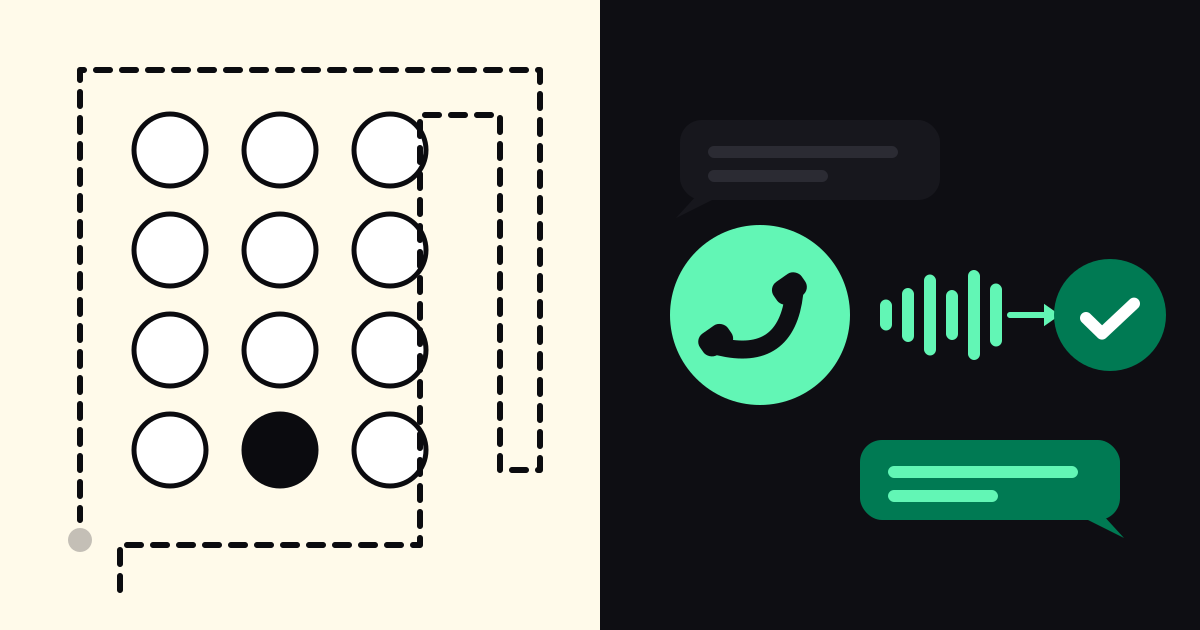
Almost everyone has been through it: you call a company, hear "for a second copy, press 1; for support, press 2", press a number, hear another menu, press another, and end up in a queue or a recording. The IVR (interactive voice response) was designed to organize service for those who receive many calls, but for the customer it often feels like a maze.
The AI attendant proposes something different: instead of a menu, a conversation. In this article, we compare the two in a practical way, so you can decide what makes sense for your company's phone line.
How the IVR works
The IVR is a tree of options. Each key leads to a branch: a recorded message, another menu, an extension or a queue. Some more modern IVRs recognize simple words ("say finance"), but the logic remains the same: the customer must fit into one of the expected options.
Where it works well:
- Routing calls between departments when there is a team waiting in each one.
- Providing fixed, short information (hours, address) without occupying anyone.
- Very large volumes, with well-defined subjects.
Where it gets in the way:
- When the customer's subject does not fit any option.
- When the menu is long and the person forgets the options before choosing.
- When, at the end of the menu, there is no one to answer. The IVR only routes; it does not resolve.
How the AI attendant works
The AI attendant answers the call and converses. The customer speaks in their own way ("I wanted to know if you have brake pads for a 2015 Gol"), the AI understands, asks what is missing and acts according to the role the company has defined. In Combot's AI Phone, that role can be:
- Sell: take the order and send it to the company's WhatsApp, with a link to contact the customer.
- Schedule: check the calendar and book.
- Note and send on WhatsApp: understand the subject and send the case to the right person on the team, with the link to contact the customer.
- Inform: answer and point to the website or WhatsApp.
The main difference is that the AI can resolve the call, not just route it.
Side-by-side comparison
Customer experience
In an IVR, the customer adapts to the menu. With AI, the conversation adapts to the customer. People who call with a simple question usually prefer to speak directly, without memorizing options.
What happens when there is no one there
An IVR, with no agent on the other end, ends in a recording or an endless queue. AI can take down the request or the message and send it to the company's WhatsApp, so the team can call back.
Maintenance
Changing an IVR usually means re-recording audio and reorganizing the tree, often with help from the phone system vendor. With AI, you change the script in text: a new piece of information, a new product, a different schedule.
Predictability
Here the IVR has the advantage: it always does exactly the same thing. AI converses, so it needs a clear script and testing to stay on track. That is why the script is the most important part of implementation (see how to write a customer service script).
Cost
Pricing models vary a lot, so compare proposals carefully. With an IVR, you typically pay for the phone system, the line and any vendor services. With Combot's AI Phone, the price is R$ 399 per month per number, with the number and 500 minutes per month included. In your comparison, also include the cost of the calls that today end without an answer.
When to use each one
- Stick with the IVR if you have a large team, well-separated departments, people available in every queue, and the only problem is distributing the calls.
- Use the AI agent if the calls are similar to one another, if many happen when there is no one to answer, or if you want the call to end with something resolved: a request taken down, an appointment booked.
- Combine both if it makes sense: AI handles and resolves what is simple, and sends what needs people to the right department via WhatsApp. In practice, it plays the role of the IVR (sorting the subjects) without forcing anyone to press keys.
An illustrative example
Think of a clinic (fictional example) with a four-option IVR: scheduling, test results, billing and speaking to the front desk. At lunchtime, all four queues land on the same empty front desk.
With the AI agent, whoever calls to book an appointment leaves with the appointment already booked. Whoever wants test results hears how to receive them, and what needs the team arrives on the front desk's WhatsApp. Whoever has a billing question has the message taken down and sent to the clinic's WhatsApp.
The front desk comes back from lunch with the appointments booked and a list of callbacks, instead of a queue of missed calls.
Questions to ask before switching
- What are the five most common reasons for calls today?
- How many of them could end resolved on the call itself?
- What happens today when no one answers?
- Who will take care of the script and review the conversations in the first weeks?
- Do you need to keep the current number, or can you advertise a new number?
Summary
The IVR organizes the queue; the AI agent answers and resolves. If your problem is distributing many calls among teams that are available, the IVR still works. If your problem is calls without an answer, customers who give up on the menu and requests that get lost, AI is the more suitable tool. To understand the AI agent from scratch, read virtual telephone agent for small businesses.