AI bot vs. menu bot on WhatsApp: which is right for your company
A menu bot is predictable and cheap; an AI bot understands free-form sentences and learns from your texts. See the differences, the costs and a simple test to decide.
WhatsApp5 min read
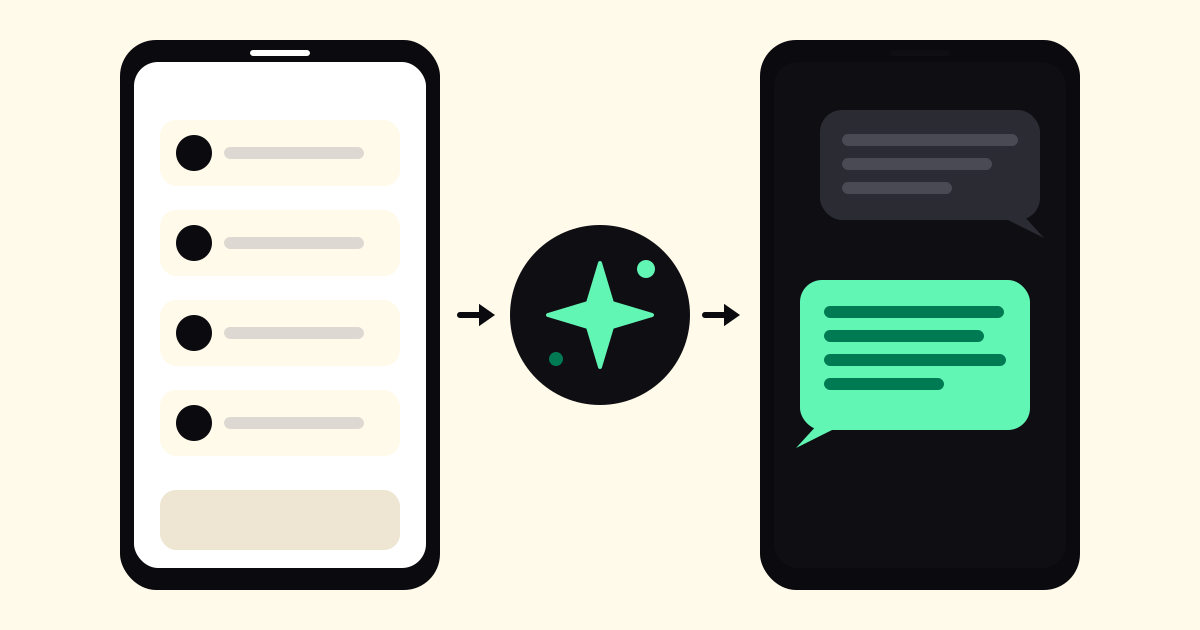
Anyone who decides to automate WhatsApp soon finds two options: the menu bot, which shows numbered options, and the AI bot, which converses in natural language. Both solve the same problem (responding without depending on someone all the time), but in very different ways.
In this article, we compare the two, show where each works best and propose a simple test so you can decide based on your own conversations.
How the menu bot works
The menu bot follows a fixed path. The customer receives options, chooses one, and receives the answer or another menu. Everything was written in advance by someone at the company.
Advantages:
- Predictable: it responds with exactly what you wrote, every time.
- Simple to set up: a menu, a few answers and you're done.
- Cheap: at Combot, it is free up to 500 responses and unlimited for R$ 49 per month.
Limitations:
- It does not understand free-form sentences. "Do you deliver to Jardim América?" is not a menu option.
- The customer has to adapt to the bot, and some give up along the way.
- The more topics there are, the more submenus, and the harder it becomes to navigate.
We cover what you can do with it in free WhatsApp bot.
How the AI bot works
The AI bot reads the customer's message, understands the intent and replies based on the information you gave it. You train the AI with the company's texts: opening hours, products, policies, frequently asked questions. It uses this to answer questions you hadn't even anticipated in exactly that form.
Advantages:
- Understands natural language: the customer writes however they like, typos and all.
- Answers several questions in a single message: "what are your Saturday hours and do you accept Pix?"
- Conversation more like a human agent: asks for what's missing, confirms, summarizes.
- Integrates with other systems: in Combot, the AI bot has an API and webhooks to connect to your ERP, CRM or online store.
Limitations:
- Depends on training. If the information isn't in the texts, the AI must not make it up, and you need to configure it to say it doesn't know and hand over to the team.
- Needs monitoring. In the first weeks, read the conversations and correct what it answered badly.
- Costs more: R$ 79.90 per month on Combot.
Practical comparison
Question off script
The customer writes: "My order from yesterday still hasn't arrived, what do I do?"
- Menu bot: shows the menu again, or hands over to the team if that option exists.
- AI bot: understands it's about a delayed order, follows what you defined for these cases (ask for the order number, say the team will check) and transfers.
Simple frequent question
"What are your hours?"
- Both handle it well. The menu requires one extra step (choosing the option).
Many different subjects
A company with dozens of services, rules and exceptions.
- Menu bot: turns into a maze of submenus.
- AI bot: handles it better, as long as the training texts are well organized.
Need for total control
An answer that must always be the same, word for word (for example, a contractual condition).
- Menu bot: ideal.
- AI bot: works, but needs clear instructions and review.
A simple test to decide
Use your own conversations, not our opinion:
- Set aside the last 50 customer conversations on WhatsApp.
- For each one, mark whether the customer started with a question that would fit in a menu of up to five options ("hours", "price", "address") or with a specific sentence ("do you have part X for car Y?", "can I bring my 40 kg dog?").
- If most fit in a menu, start with the menu bot.
- If most are specific questions, the AI bot will serve you better.
There's no problem starting with the menu and changing later. Many companies do it this way: they use the free bot to learn what customers ask and, with those questions in hand, train the AI.
How to train an AI bot well
- Write the information as short facts. "We deliver Monday to Saturday, from 9 a.m. to 6 p.m., in neighborhoods X, Y and Z."
- Include what NOT to do. "Do not give delivery times for outside the city; transfer to the team."
- Define when to transfer: complaint, negotiation, cancellation request.
- Always keep it updated: price changed, holiday hours, new product.
- Read the conversations every week at the start and correct the texts.
The same reasoning applies to a phone agent's script. We have a guide: how to write a customer service script.
Data and privacy
An AI bot reads what the customer writes, and the customer sometimes writes personal data. Ask only for what's necessary, don't ask for sensitive data without reason and inform how the data is used. More details in LGPD in phone and WhatsApp customer service.
What about the phone?
If, besides WhatsApp, your company receives many calls, there's a voice equivalent: AI Phone, which answers with a natural voice and can send orders to your WhatsApp.
Frequently asked questions
Can the AI bot make up answers?
It may try to fill gaps if it isn't well instructed. That's why the training must state clearly: when the information isn't in the texts, say you will check and hand over to the team.
Do I need to know how to program to use the AI bot?
No. Training is done with ordinary texts, in the dashboard. The API and webhooks are optional, for those who want to connect customer service to another system.
Can I use it on the number the company already has?
Yes. WhatsApp can be connected via QR Code, on the current number, or via Meta's official API, on a new number.
Summary
The menu bot is the right choice when questions are few and predictable, and when cost matters. The AI bot is the right choice when customers write in a thousand different ways, there are many subjects and you want to integrate customer service with other systems. Look at your real conversations, do the 50-message test and decide with your own data. The name search most often uses for the AI bot is in WhatsApp agent and menu bot.